Insights
Property Management for Family Offices in Montreal
Property management for family offices Montreal stakeholders can rely on requires more than arranging repairs when something breaks. It requires a local operating system that connects the property, the people responsible for it, the records that document decisions, and the family office stakeholders who need clear visibility without taking on daily building administration.
Request a proposal from PGK Realty Services for your Montreal property operations.
In brief: A strong family-office property-management arrangement assigns clear responsibilities, produces consistent financial and operational reporting, coordinates qualified vendors, and maintains an inspection and escalation process. For Montreal assets, local bilingual oversight can turn scattered property tasks into a documented service model that supports owners, trustees, wealth managers, and remote decision-makers.
What should property management for family offices in Montreal cover?
Property management for a family office should cover the complete operating cycle, not only tenant requests. The scope typically includes maintenance coordination, bookkeeping, rent collection, leasing, tenant communication, inspections, vendor supervision, records, and escalation. The right model is defined by the family's governance needs, asset mix, and preferred level of involvement.
Family offices often coordinate several parties around one property or a mixed portfolio. The owner or family representative may set the priorities. A wealth manager or trustee may need formal reporting. An accountant may need organized supporting records. Tenants and vendors need timely local communication. A property manager makes those relationships workable by giving each participant a clear channel and a defined responsibility.
For a Montreal portfolio, the operating scope may include:
- Financial administration: rent collection, bookkeeping, owner statements, invoice coordination, and records that support review.
- Building operations: preventive maintenance, repair requests, emergency coordination, common-area oversight, and project follow-up.
- Occupancy and leasing: tenant communication, leasing support, renewals, inspections, and practical coordination with occupants.
- Property condition: routine inspections, vacant-property checks, photographs, issue tracking, and recommendations for corrective work.
- Vendor management: obtaining scopes of work, coordinating access, confirming completion, and keeping service history with the property records.
- Stakeholder communication: bilingual communication in English or French, clear escalation routes, and reporting that can be understood by remote stakeholders.
This is an operating guide, not investment, tax, legal, or estate-planning advice. A family office should keep those decisions with its qualified advisers. The property manager's role is to execute and document the local property work within the authority the client has approved.
PGK Realty Services describes its work as real estate management for residential, commercial, and industrial properties. Its full-service property management offering can be relevant when a family office wants one local point of coordination, while a partial-management arrangement can be appropriate when the family office retains control of selected functions.
How should a Montreal family office structure property reporting?
Reporting should give decision-makers the right information at a predictable cadence, with enough detail to trace a material expense or operational issue. A useful reporting model separates financial results, open work, property condition, tenant matters, and decisions requiring approval. It should be consistent across properties while allowing for asset-specific risks.
A family office does not need a report that merely repeats every email exchanged during the month. It needs a management record that answers practical questions:
- What happened at each property during the reporting period?
- Which work orders remain open, and why?
- Which expenses were routine, unexpected, or waiting for approval?
- Are there vacancies, lease events, tenant concerns, or access issues requiring attention?
- What condition or maintenance trends could affect the next reporting period?
- Which decisions belong to the family office, trustee, or other authorized stakeholder?
A useful cadence can be organized as follows:
| Reporting layer | What it should show | Typical use |
|---|---|---|
| Event-based alert | Urgent damage, safety concern, service interruption, or material tenant issue | Prompt authorization and escalation |
| Monthly operating report | Income collected, expenses, open work, tenant activity, inspections, and variance notes | Routine family-office and adviser review |
| Quarterly review | Recurring maintenance patterns, vendor performance, larger projects, and operating priorities | Portfolio-level planning |
| Annual planning review | Insurance review, maintenance priorities, service scope, and reporting requirements | Renewal and governance decisions |
The exact format should be agreed before work begins. A family office may require a consolidated view across several assets, while a trustee may require supporting documentation at the property level. The key is not to promise a report template that has not been agreed. It is to define what information must be available, who reviews it, and how exceptions are elevated.
PGK Montreal's established property-management positioning includes bookkeeping, rent collection, inspections, and service coordination. Those functions can create a practical foundation for a family office that wants local execution with a professional reporting relationship rather than a collection of disconnected contractors.
For a portfolio review, explore PGK's property management services and request a scope that matches your reporting and approval requirements.
How should maintenance and vendor oversight work?
Maintenance oversight works best as a controlled process from issue identification through completion, not as a list of vendor phone numbers. The manager should establish the urgency, document the required work, coordinate access, confirm the scope, monitor progress, and close the record when the property is restored. That process gives remote stakeholders a defensible history of what was done and why.
Family offices should ask how the property manager handles the following stages:
- Intake: Record the issue, location, reported impact, photographs where useful, and the person who identified it.
- Triage: Decide whether the issue is an emergency, a time-sensitive repair, preventive maintenance, or a project requiring planning.
- Authorization: Apply the agreed spending authority and obtain approval when the work exceeds the manager's mandate.
- Vendor coordination: Select an appropriate service provider, confirm access requirements, and communicate the expected scope.
- Quality control: Confirm that the work is complete, safe, and consistent with the agreed scope before closing the item.
- Recordkeeping: Retain the invoice, completion note, photographs, and any recommendation for follow-up or preventive work.
This sequence is especially important when the family office owns different asset types. A residential building may require fast tenant communication and common-area coordination. A commercial building may require access planning around occupants and business hours. An industrial property may involve specialized contractors and more complex operational constraints. The process can stay consistent while the technical response is adapted to the asset.
Vendor oversight should also include institutional memory. The family office should not have to reconstruct the property's service history every time a manager, contractor, or stakeholder changes. A maintained record of recurring issues, warranties, inspection findings, and service contacts protects continuity and helps reveal patterns before they become larger disruptions.
PGK Realty Services presents maintenance coordination, emergency response, bookkeeping, property inspections, and project management as parts of its broader real estate-management capability. The appropriate scope should be confirmed in the proposal, especially when the portfolio includes commercial or industrial properties.
What should a local inspection program include?
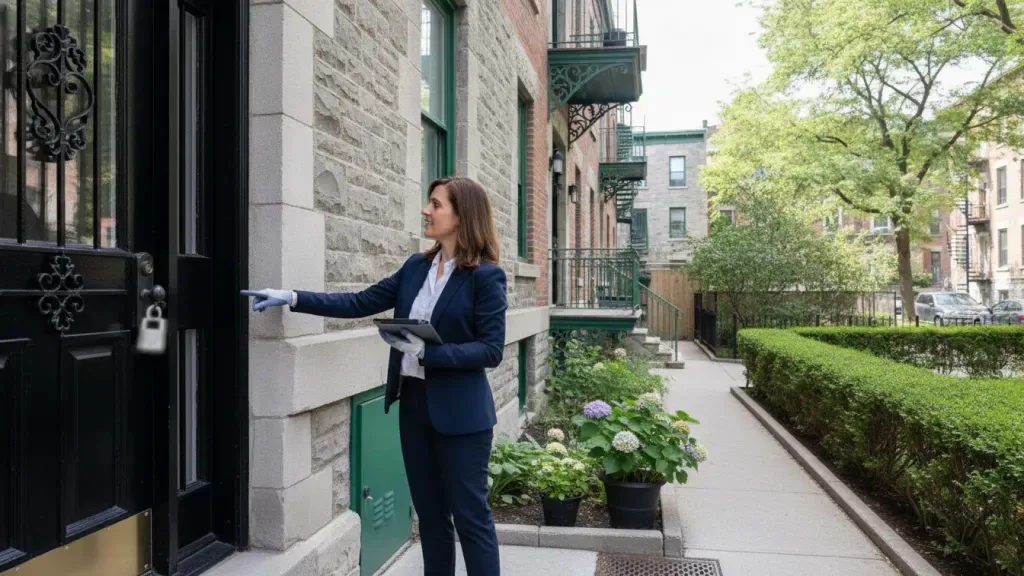
A local inspection program should create reliable evidence of property condition, identify problems early, and give remote stakeholders a clear path from observation to action. The schedule and checklist should reflect whether the property is occupied, vacant, residential, commercial, or industrial. Each inspection should produce a concise record of findings, photographs when relevant, and recommended next steps.
For vacant properties, the inspection program may be especially important because there is no resident or tenant reporting everyday changes. A practical checklist can cover:
- Exterior access points, doors, windows, roofline, drainage, and visible signs of intrusion.
- Interior water, heating, electrical, humidity, pest, and damage indicators.
- Temperature and winterization considerations during Montreal's cold-weather season.
- Mechanical areas and visible signs of leaks, unusual noise, or deterioration.
- Common areas, lighting, security, cleanliness, and any safety concern.
- Actions required, urgency, responsible party, and date for follow-up.
PGK's vacant property inspection service describes weekly interior and exterior checks, winterization protocols, photographic documentation, and 24-hour emergency response. These are specific operational signals a family office can evaluate when it wants local visibility for an unoccupied Montreal asset. The family office should still confirm the inspection frequency, report format, response standards, and approval limits in writing.
Inspections are not a substitute for a specialist assessment when a qualified engineer, contractor, environmental professional, or other adviser is needed. They are an operating control that helps the responsible team notice conditions, coordinate the right response, and preserve a timeline of property care.
How should a family office coordinate tenants, leasing, and communication?
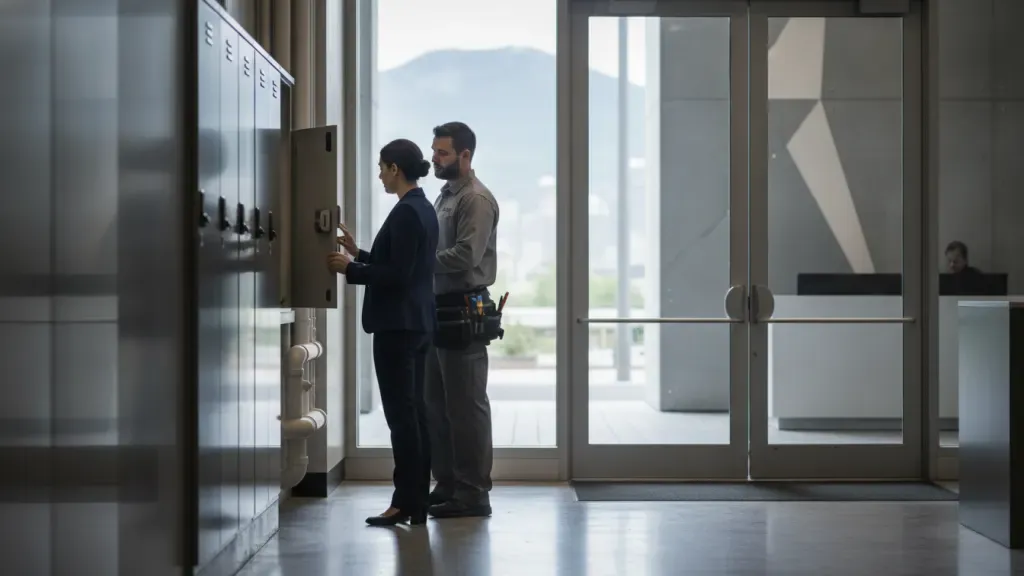
Tenant and leasing coordination should protect the property's operating continuity while keeping the family office out of routine administrative traffic. The manager should define who tenants contact, how requests are logged, when issues are escalated, and how leasing events are reported. This allows the family office to remain informed without becoming the day-to-day service desk.
The communication model should address both normal operations and exceptions. Normal operations include rent collection, maintenance requests, access arrangements, lease administration, inspections, and updates to occupants. Exceptions include significant damage, repeated service failures, a sensitive tenant matter, a vacancy risk, or an issue that could affect the property's reputation or income.
For a mixed portfolio, communication protocols should be adapted to each building. A multi-unit residential property may require consistent tenant notices and fast maintenance routing. An office or commercial complex may require coordination with several occupants, building schedules, and access restrictions. An industrial property may require more detailed vendor and safety coordination. The family office should receive the decision-relevant summary, while tenants receive practical instructions from the designated local contact.
Leasing administration can also be separated from investment decisions. The property manager may coordinate showings, applications, documentation, tenant communication, and handoff. The family office and its advisers retain authority for decisions that fall outside the agreed management mandate. Clear boundaries reduce delays and prevent an unplanned chain of approvals from becoming an operational bottleneck.
PGK Montreal serves property owners in Greater Montreal and provides English and French service. That bilingual capability can support communication with local tenants, vendors, and remote stakeholders when the portfolio requires both languages.
Which operating model fits a family office?
The right operating model depends on how much local execution the family office wants to retain, how complex the properties are, and how much coordination its internal team can reliably provide. Full management creates one accountable local operating relationship. Partial management preserves family-office control over selected functions while delegating specialized or time-sensitive work. The decision should be based on responsibilities, not on a generic label.
| Model | Can suit a family office when | Questions to resolve |
|---|---|---|
| Complete management | The office wants local coordination for operations, tenants, vendors, inspections, bookkeeping, and rent collection. | What authority limits, reports, and escalation rules apply? |
| Partial management | The office has internal resources and wants to delegate only leasing, inspections, maintenance, accounting, or another defined function. | Who owns handoffs, response times, and the complete property record? |
| Inspection-focused support | The office mainly needs recurring local visibility for vacant or remote properties. | How are findings documented, escalated, and connected to repairs? |
| Project or transition support | The office is onboarding a property, changing vendors, or coordinating a defined improvement. | What is the start and end point, and who takes responsibility afterward? |
A family office should request a proposal that states the properties covered, the exact services included, the reporting cadence, the emergency process, spending authority, vendor responsibilities, communication channels, and exclusions. Pricing should be treated as proposal-based because the appropriate scope varies by property type, size, condition, occupancy, and service complexity.
PGK has served property owners since 1986 and positions its services for residential, commercial, and industrial real estate. It also describes experience with international property owners and institutional clients. Those facts may be relevant to a family office, but the fit should be tested through a specific discussion of the portfolio, reporting expectations, and operating handoff.
For additional context, a family office can review PGK's institutional property-management guide for the broader reporting and accountability context, then use this article's operating questions to define the local family-office scope. The international-investor guide is a separate reference for owners managing Montreal assets from abroad.
Frequently asked questions about family-office property management in Montreal
What does a family-office property manager do?
A family-office property manager coordinates the local operation of one or more properties. Depending on the agreed scope, that can include maintenance, bookkeeping, rent collection, tenant and leasing coordination, inspections, vendors, reporting, and emergency response. The manager provides the local execution and records, while the family office retains the decisions assigned to it.
Can a family office use partial property management?
Yes. Partial management can delegate a defined function, such as inspections, maintenance coordination, leasing, rent collection, or bookkeeping, while the family office retains other responsibilities. The proposal should identify boundaries, handoffs, response expectations, approval limits, and who maintains the complete operating record.
How often should Montreal properties be inspected?
The appropriate schedule depends on occupancy, property type, risk, insurance requirements, season, and the owner's operating plan. Vacant properties generally need a defined recurring protocol. PGK describes weekly vacant-property inspections with interior and exterior checks, winterization, photographs, and emergency-response capability. The final schedule should be documented for the specific property.
What should a family office ask for in a property-management proposal?
Ask for the service scope, property coverage, reporting cadence, inspection process, maintenance and vendor workflow, tenant communication model, emergency escalation, spending authority, records, bilingual support, exclusions, and proposal-based fees. Also clarify how the manager will coordinate with trustees, wealth managers, accountants, and other authorized stakeholders.